
Guest blog: Reflections on the RED
Andy Lewis
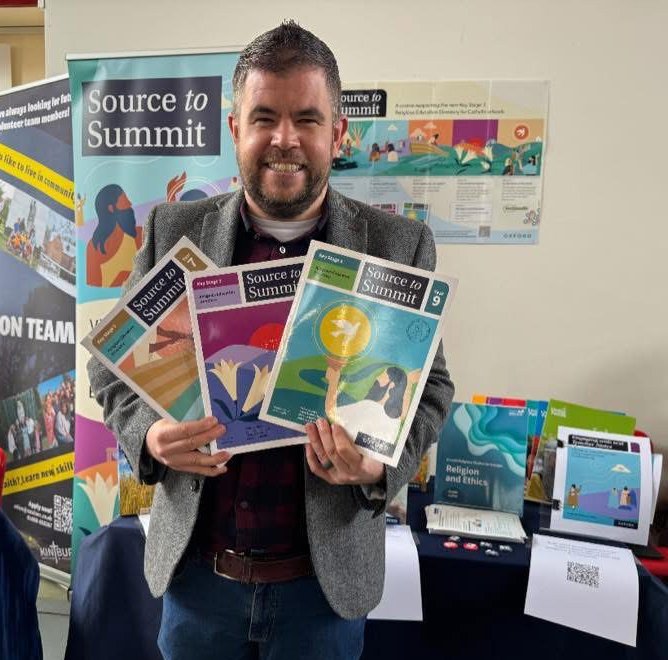
Andy is an RE teacher and Deputy Headteacher at St Bonaventure’s in East London, Diocese of Brentwood. He is the author of a number of books including GCSE textbooks, workbook and revision guides, !00 Ideas for Outstanding RE Lessons and the upcoming Succeeding as an RE Teacher. He is also the series editor for the Key Stage 3 ‘Source to Summit’ RED textbooks.
Andy Lewis: Reflections on the RED
“Crises are also windows of opportunity,” says Pope Francis in the reader for Laudato Si’. While he was addressing global ecological, social, and healthcare crises, many might argue that a crisis also exists within Catholic education in England and Wales - there is a ‘perfect storm’ of a declining number of practising Catholics to teach and lead, limited teacher knowledge and catechesis of Catholic traditions, and a noticeable changing demographics of students.
In the midst of this, in January 2023, the new Religious Education Directory “To know You more clearly” was published. Was this the ‘window of opportunity’ that Pope Francis envisaged for our RE classrooms? It was a document that superseded the 2012 and 1996 RECDs (Religious Education Curriculum Directories) - these publications have outlined “the broad content of the religious education which [they] as bishops expect to be taught in Catholic schools.” (RECD 1996, p.5). However RED (2023) appeared to many to demand a much higher level of academic rigour, more indepth theology and a far greater investigation of scripture.
The initial response was overwhelmingly one of trepidation and concern - how was this going to be implemented successfully given the ‘perfect storm’ as outlined above? Alongside budgetary challenges and the emergence of a changed landscape post-pandemic.
I had the privilege, via ATCRE (The Association of the Teachers of Catholic RE), of being part of the group that consulted and contributed to the RED. At the time, it felt like we were undertaking something hugely significant. Not just devising a new curriculum and deciding what goes where and when, but that we were on a threshold and undertaking something much bigger than any of us - we were working for the Church, and as a fundamental part of the Church - with Catholic education one of the single most important things to get right in the current times.
The opportunity then emerged, as we had prayed for, to unite with the team at Oxford University Press who had previously made a huge commitment to Catholic GCSE publishing, and work on resourcing the RED. Unless you have done it, it is impossible to fully understand the commitment required to write textbooks and their accompanying resources, while teaching and leading RE departments full time. That sense of vocational, and the inspiration of the Holy Spirit, lead to nearly three years of working on Source to Summit. However, at the same time we were introducing it in our own schools and realising it was possible, but seeing it’s transformational power.
We felt that we were attempting to lift the burden being felt by RE teachers. We worked so hard to translate the ‘model curriculum’ into an accessible, relevant, engaging and beautiful set of resources. And as we did so, we realised that we were not alone. Like in the Early Church, in different places, and different ways, there were people working on a variety of different projects and resources to help teachers not only survive implementing the RED but really ensure RE was thriving in their schools - we were truly ‘one body, many parts’ (1 Cor 12:12).
On a personal note, I had already been on this journey with the GCSE in 2016 - I endured personal criticism about the demands of the ‘new GCSE’ as it was then, and it’s “complete impossibility” - despite having had nothing to do with its writing! I was simply working on a textbook in a very short space of time (in publishing terms). People said it was “too theological” and “too much content”. Anecdotally, my new Year 10 class, who have studied the new RED from Year 7 are finding it really straightforward and are already experts on creation, incarnation, salvation and eschatology!
Helen Bridges, Founder and Director of Magister Resources, explains, “One of the greatest strengths of the RED is its cyclical design - pupils revisit key themes each year, allowing their understanding and faith to deepen over time. The Holy Spirit has truly been at work within the Magister team; we have resourced the RED with curriculum materials from EYFS to Year 9, witnessing firsthand the beauty, depth, and rigour of what pupils now experience. As we move into writing assessment material, it is plain to see the skills pupils are enabled to develop through this cyclical structure. It’s an exciting thought that, in a few years’ time, a child who has journeyed through this curriculum will emerge with a solid grounding in the Catholic faith and a wealth of transferable skills to contribute to society.”
Helen adds, “Another tremendous benefit of the RED is the wealth of new resources that have emerged from various providers in response to it. Never before have teachers had such a range of high-quality options to support them in their vital mission, and it’s inspiring to be part of this renewed effort to share the faith with young people. As Brenden Thompson reminded us at the ATCRE conference, schools are “the Church’s biggest mission field,” and it is a true privilege to contribute to this renewal and play a part in shaping the future of the Church through education.”
It is important to recognise that not all challenges have yet been overcome. Resources for primary schools were slower to emerge than those for primaries, creating a significant workload initially. As Barbara Meaney of the ATCRE Exec and St Michael’s High Wycombe shared, “There also remains a real difficulty to support some of our Year 7 students who have not been to Catholic primaries and experienced the RED as they have big gaps in their knowledge.”
Barbara continues, “It would also be really useful to get clear assessment guidance that accompanies the RED.” - this is a common question and concern from teachers as the curriculum begins to embed.
There is ongoing work around assessment as well as Key Stage 4 and 5 RED content. The latter, will be a vital development for 6th Form ‘core’ RE which has struggled for many years with being 5% of the curriculum but without any guidance or curriculum content.
It is my personal belief that this curriculum is part of our collective catechesis - to staff, students and their families at a time when many are not in Mass every week or receiving other sacraments. There is a very real responsibility to be missionary witnesses - to bring our faith to life in the classrooms in an authentic but relevant way. We must have faith in our vocational call to Catholic education, and the call to deliver the RED. We need to be part of a “city built on a hill” (Mt 5:13) giving light to all.
Resource summary:
Source To Summit is a series of textbooks written by classroom teachers for Years 7 to 9 that have been called “stunningly beautiful” and are accompanied by an extensive set of editable assessments, activity worksheets, ‘Engaging with text’ resources and much more!
Source to Summit: Lighting the Path is a complete primary resource that includes teacher guides, eBooks, lesson plans, Powerpoints and activity sheets.
Magister Resources creates classroom-ready materials that save teachers time and enhance the quality of RE, while fostering an authentic encounter with the Catholic faith.
Other resources include Day by Day by St Mary’s and A&B Diocese, Spirit and Life by Hachette, RE Deep Dive by Ten:Ten, Mustard Seeds videos as well as those created by charities such as CAFOD and Mission Together (MIssio)
NB - It is recommended that schools follow the direction of their Diocese when selecting resources, as well as ensuring resource compliance via the Catholic Education Service endorsement process and that nil obsstat / imprimaturs have been issued for resources used.